If Our Crops Fail, We Fail – Farming, Climate Change and how you can make a difference
If Our Crops Fail, We Fail – Farming, Climate Change and how you can make a difference by Cora Moran (2025). Independent Publishing Network. ISBN 978-1-83654-756-3
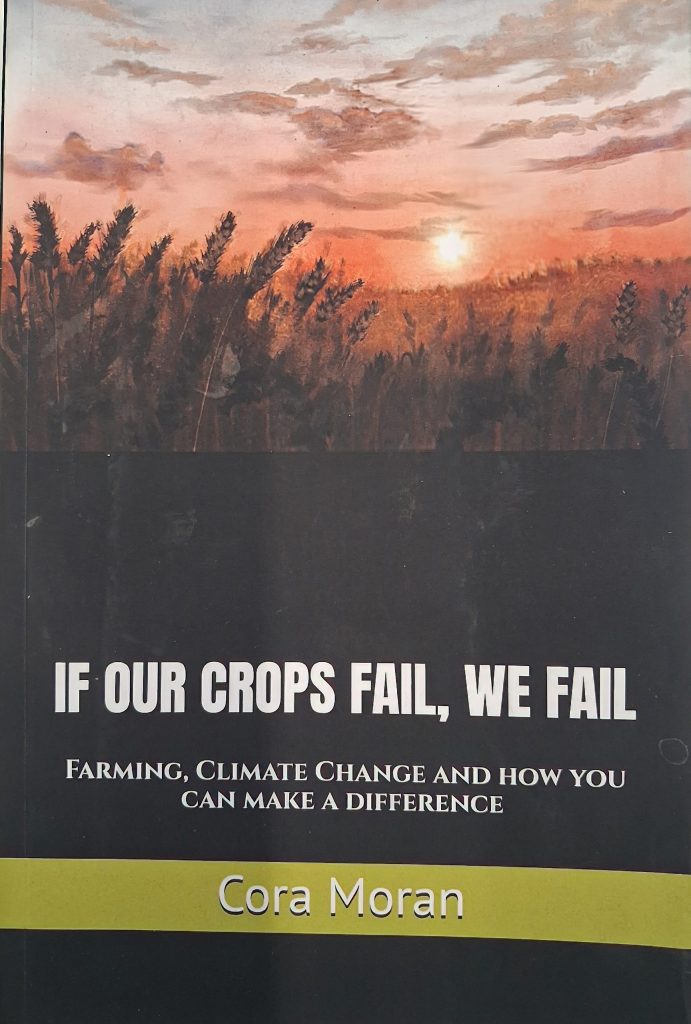 With the climate crisis and food security now almost daily parts of our news and political discussion, this is a timely book. Cora Moran gives us a readable layperson’s primer on the subject, well researched and well referenced, but leavened by a lively, conversational style.
The author begins by laying out a positive case for individual and community action, taking back a measure of control in the face of a seemingly intractable and inevitable global crisis in food production. She then explains some of the science behind climate change and the precarious state of our agriculture and farming systems, and outlines some of the political and philosophical debate surrounding these topics. Moran highlights the fundamental inequalities in access to land and to affordable, healthy food supplies – both between the well-off and the poor and between the developed world and the global south.
The middle section of the book maps out some practical steps that can be taken at an individual or local level, to mitigate our climate impact and improve access to good food. Based on the author’s own experience of vegetable growing, her model is described as the Scottish Kitchen Garden and is adaptable for urban settings from small garden to tenement back greens or community allotments. Without going into the depth of a gardening manual, Moran explains some methods of cultivation, outlining the importance of planning for each particular site and describing some of the more useful, easy crops to help provide a level of nutritional self-sufficiency.
Drawing again on her own experience, she also invites us to experiment with some more unusual crops that may prove more resilient in a changing climate. Mashua (Tropaeolum tuberosum) is a South American relative of the Nasturtium that produces both edible leaves and tubers. Caucasian Spinach (Hablitzia tamnoides) is a perennial climber unrelated to our usual spinach, producing an early spring supply of nutritious leaves. Oca (Oxalis tuberosa) is another South American plant providing both tubers and edible leaves that can be used in salads.
For those interested in keeping garden livestock, Moran devotes a chapter to the husbandry of the Coturnix Quail, which she describes as a charming and hardy little bird. Apparently they have an extremely fast growth rate and can provide up to 300 eggs per year.
The third section of the book outlines some alternatives to industrial agriculture, including organic growing and an excellent summary of permaculture philosophy and practice. The author ends with some modest proposals for wider reform of agriculture systems, food production, farming policy and social policy.
As Moran says, this book is ‘an antidote to despair’. Instead she points us towards practical growing methods that all of us can use to make a difference, to improve our own resilience – methods that are community-friendly and communitarian in spirit.
Coran Moran is an agricultural researcher and qualified horticulturalist. She has degrees in Environmental Sustainability and Anthropology, and many years of practical experience as a gardener.
Reviewer: Chris McKinnell – Caley Education Committee member
This book is available in the Caley Library
Discover more from RCHS
Subscribe to get the latest posts sent to your email.